Google Maps Earth
Google Maps Earth represents the powerful combination of Google Maps and Google Earth — two of the world's most widely used geographic exploration tools. While Google Maps focuses on navigation and driving directions, Google Earth takes exploration to the next level with stunning 3D satellite imagery, virtual flyovers, and immersive tours of our planet. Together, Google Maps Earth capabilities allow users to seamlessly switch between practical navigation and breathtaking global exploration, making it the ultimate geographic discovery platform.
From zooming in on your neighborhood to flying over the Grand Canyon in 3D, Google Maps Earth brings the entire world to your fingertips with unprecedented detail and interactivity.
What Is Google Earth?
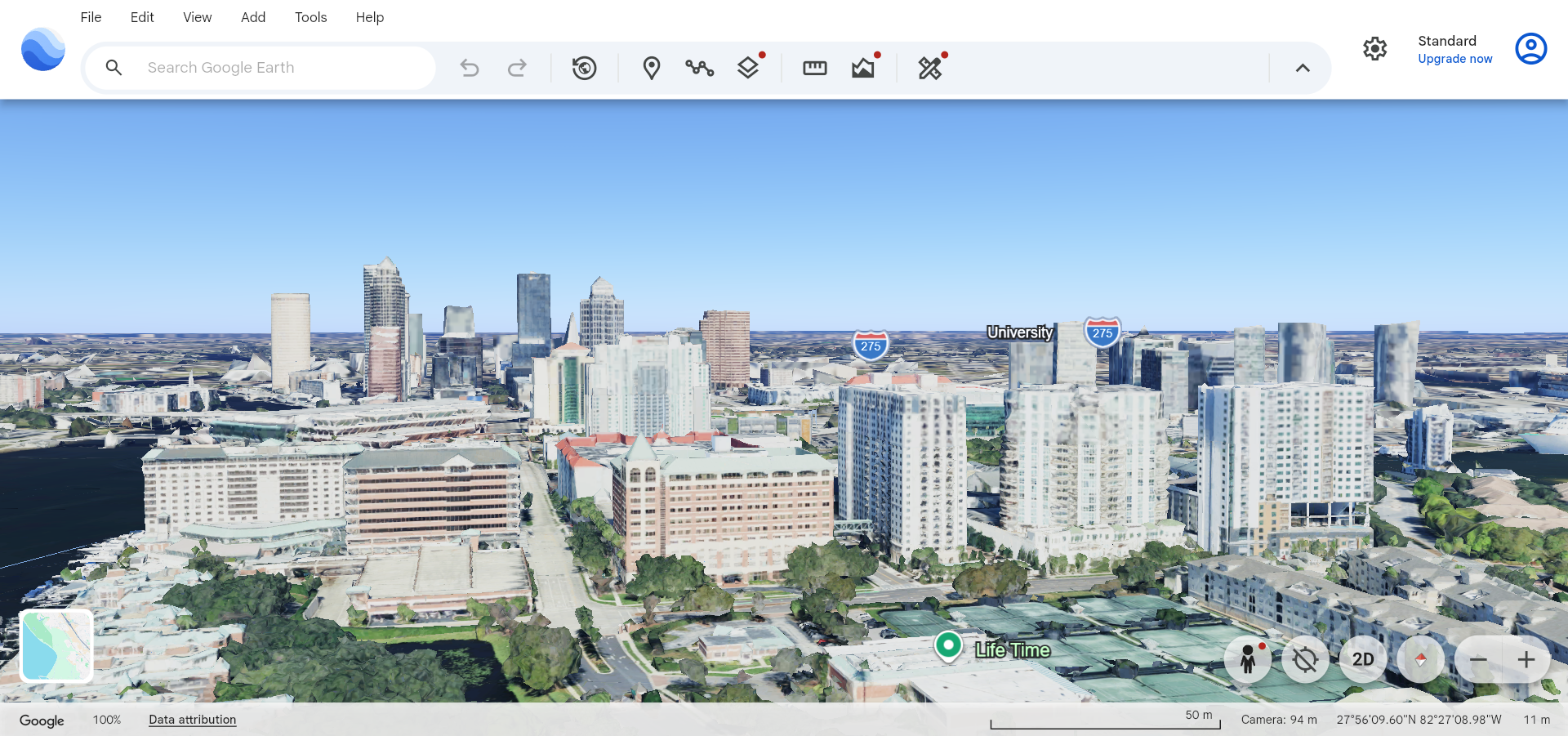
Google Earth is a computer program and web application that renders a 3D representation of the Earth based primarily on satellite imagery, aerial photography, and geographic data. Unlike standard Google Maps, Google Earth provides a fully three-dimensional, interactive globe that users can spin, zoom, and tilt to explore any location from virtually any angle.
Google Earth is available in three forms: the web version accessible at earth.google.com, the desktop application (Google Earth Pro), and the mobile app for Android and iOS. Each version offers slightly different features, but all provide the core Earth viewing and exploration experience.
How to Access Google Earth Features
Through Google Maps
- Open Google Maps and switch to Satellite View to see aerial imagery.
- Enable 3D mode by holding Ctrl and dragging the mouse (desktop) or using two fingers to tilt (mobile) to see 3D buildings and terrain.
- Zoom into cities with 3D building data to see realistic three-dimensional cityscapes.
- Click "Google Earth" in the Layers menu to access additional Earth features directly from Google Maps.
Through Google Earth App
- Visit earth.google.com in your web browser or download the Google Earth app.
- Search for any location to fly there instantly with a smooth 3D animation.
- Explore Voyager stories — curated guided tours of fascinating places around the world.
- Use the time slider to view historical satellite imagery dating back decades.
Key Features of Google Maps Earth
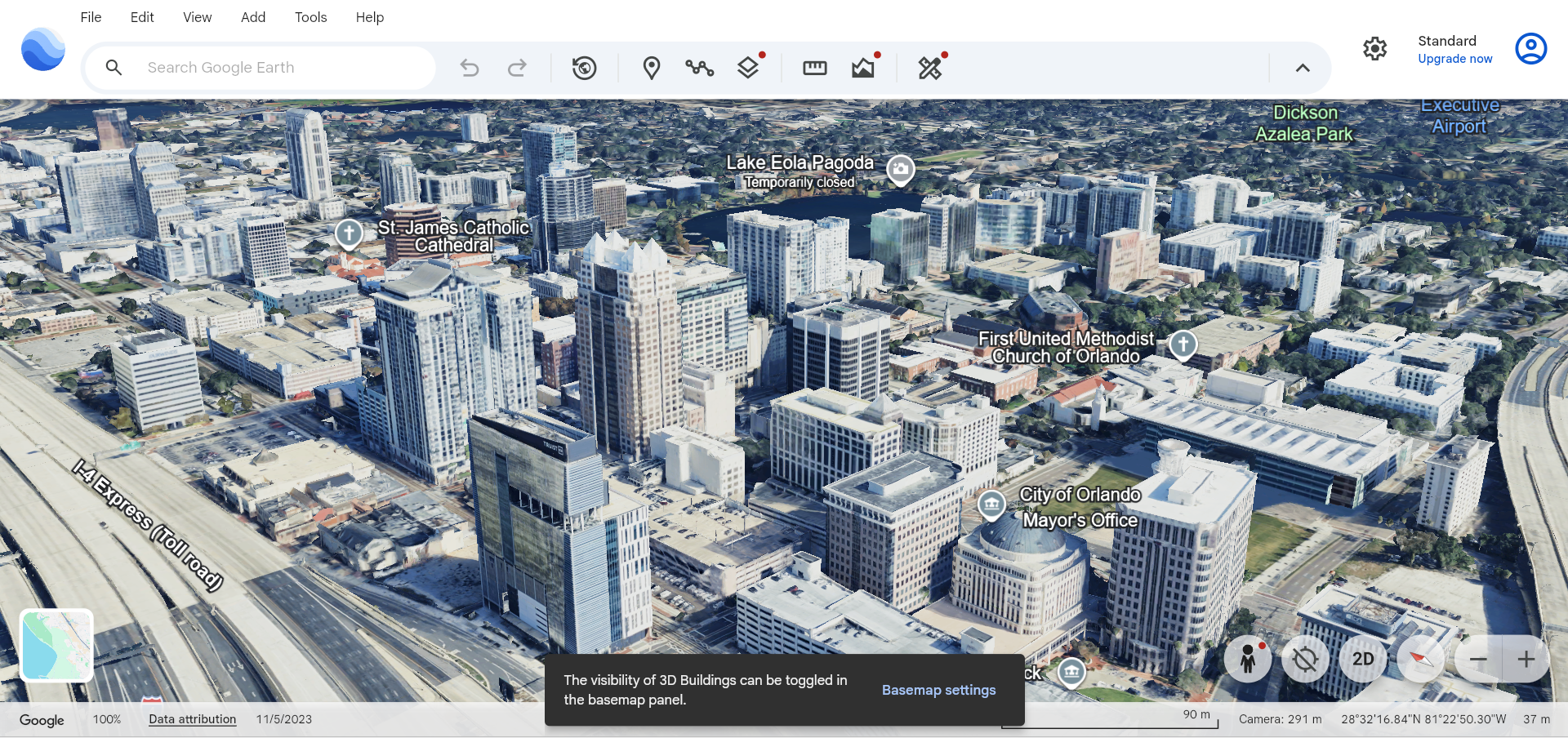
- 3D Satellite Imagery — View photorealistic 3D models of cities, mountains, valleys, and landmarks from any angle. Major cities like New York, London, Tokyo, and Paris feature highly detailed 3D building models.
- Historical Imagery (Timelapse) — Google Earth's Timelapse feature shows how the planet has changed over decades. Watch cities grow, glaciers shrink, forests disappear, and coastlines shift through animated satellite imagery from 1984 to present.
- Voyager — A collection of guided tours, quizzes, and stories created by scientists, researchers, and organizations. Explore topics like climate change, wildlife migration, cultural heritage, and space exploration.
- Measure Tool — Measure distances between points and calculate areas of regions directly on the 3D globe.
- Street View Integration — Seamlessly transition from the aerial perspective of Google Earth down to street-level imagery with integrated Google Maps Street View.
- KML/KMZ Support — Import and export geographic data files (KML/KMZ) to create custom maps, overlays, and projects in Google Earth Pro.
- Ocean and Space Exploration — Explore the ocean floor with bathymetric data and venture into outer space to explore the Moon and Mars.
Google Maps vs. Google Earth
While both tools use similar data sources, they serve different primary purposes:
- Google Maps — Designed primarily for navigation, driving directions, finding businesses, and practical location services. Best for getting from point A to point B.
- Google Earth — Designed for exploration, education, and geographic analysis. Best for viewing 3D imagery, studying terrain, and exploring the planet.
- Overlap — Both share satellite imagery, Street View, and basic search functionality. Google Maps includes a simplified satellite view, while Google Earth provides the full immersive 3D experience.
Practical Applications
- Education — Teachers use Google Earth for virtual field trips, geography lessons, and environmental science education. Students can explore volcanoes, rainforests, deserts, and historical sites interactively.
- Environmental Research — Scientists use historical satellite imagery to track deforestation, urban expansion, glacier retreat, and other environmental changes over time.
- Urban Planning — City planners use the 3D views and terrain data to visualize proposed developments, analyze land use patterns, and plan infrastructure projects.
- Real Estate — Property professionals use aerial views to assess properties, evaluate surrounding areas, and present location information to clients.
- Storytelling — Journalists, filmmakers, and content creators use Google Earth's creation tools to build visual narratives and geographic stories.
Frequently Asked Questions
- Is Google Earth free? — Yes, all versions of Google Earth including Google Earth Pro are completely free to download and use.
- Do I need to install software for Google Earth? — No, you can access Google Earth directly in your web browser at earth.google.com. However, Google Earth Pro can be installed as a desktop application for advanced features.
- Can I see real-time satellite imagery on Google Earth? — No, Google Earth uses periodically updated satellite imagery, not live feeds. Images may be anywhere from a few months to a few years old depending on the location.
- Can I create my own tours in Google Earth? — Yes, Google Earth's creation tools allow you to build custom projects with placemarks, routes, and narratives that you can share with others.